Impact
Thailand's dairy genetic evaluation begins
DPO, KU and the University of Florida begin the yearly dairy sire evaluation.
About
He has taught animal breeding at Kasetsart University since 2003 and has advised about 65 graduate theses, 31 as main advisor. The research unit he founded works with farmers, cooperatives and companies to decide which animals should parent the next generation, from dairy cows and buffalo to fish and shrimp.

Biography
He founded and leads the Tropical Animal Genetic Special Research Unit (TAGU) at Kasetsart University. The unit develops genetic and genomic evaluation methods, selection indexes and mating plans for dairy and beef cattle, swamp buffalo, pigs, chickens, fish and shrimp, and puts them to work with farmers, cooperatives and industry.
His best-known work is Thailand's dairy cattle genetic evaluation, run by the Dairy Farming Promotion Organization of Thailand with KU and the University of Florida since 1996, and its genomic version, built in a KU-funded project (2015–2017) and now used by DPO. With genomic evaluation, farmers obtain genetically superior replacement cows about 7.4 months (14.8%) sooner (KU, 2020).
His Kasetsart University profile lists adjunct appointments at Florida and Guangxi and a visiting appointment at Tsukuba; he was courtesy faculty at Florida in 2005–2023. He is academic adviser to the Suan Chitralada royal project and serves on the support team of the Thai Buffalo Conservation and Development Project.
Career
1996
Impact
DPO, KU and the University of Florida begin the yearly dairy sire evaluation.
1997
Academic post
Completes his M.S. and joins the Rajamangala Institute of Technology in Sakon Nakhon as a lecturer.
2003
Academic post
Becomes a lecturer in the Department of Animal Science and Assistant Dean for Planning & International Affairs.
2004
Academic post
Promoted to Assistant Professor; helps set up KU's Agribusiness Center and a double-degree program with Victoria University, Australia.
2005
Academic post
Begins an 18-year courtesy appointment in Animal Breeding and Genetics at the University of Florida.
2014
Leadership
Leads research strategy for the Faculty of Agriculture until 2017.
2017
Academic post
Promoted to Associate Professor; becomes Chair of the Graduate Program in Animal Science and a journal Editor-in-Chief.
2019
Impact
Honored by the Myanmar Livestock Federation for his work on Myanmar dairy development.
2022
Academic post
Appointed Professor of Animal Breeding (effective 4 Feb 2022; Royal Gazette, Jan 2026).
2023
Impact
Leads KU's side, with the CP Foundation's Buffalo Modern Farm, in publishing genetic evaluations for Thai swamp buffalo.
2026
Leadership
Oversees KU's research centers and stations, KU Radio and the Princess Sirindhorn Center for Sustainable Development.
 National Outstanding Researcher 2026, Agricultural and Biological Sciences · KU Research and Development Institute (opens in a new tab)
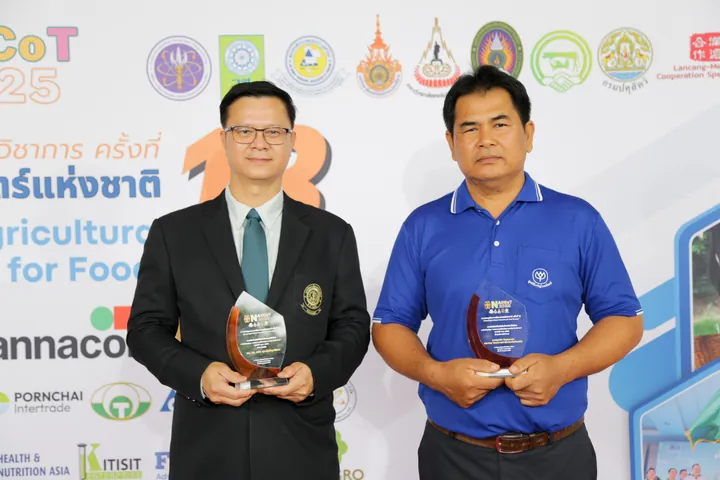 Receiving the Outstanding Thai Buffalo Researcher award at NASCoT 2025 · CP Group (opens in a new tab)
 Receiving the Platinum-level Impactful Research Award at Kasetsart University, October 2024 · KU Research and Development Institute (opens in a new tab)
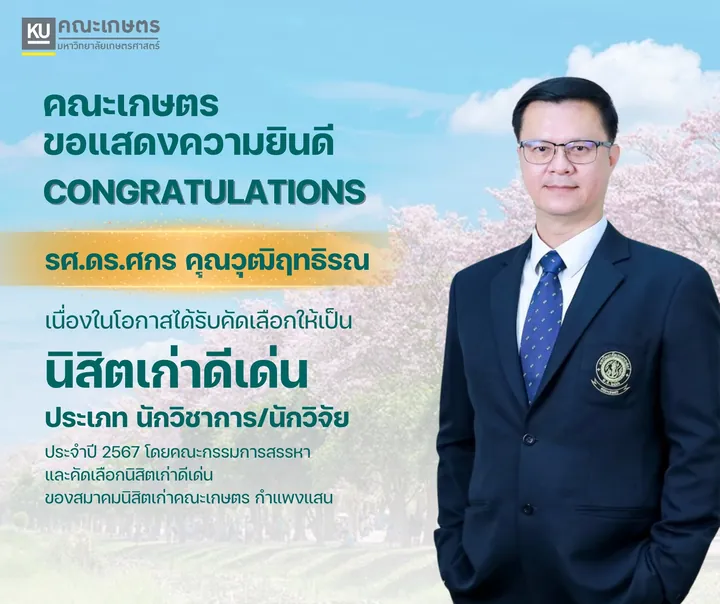 The Faculty of Agriculture congratulates him as an Outstanding Alumnus 2024 (academic/researcher) · KU Faculty of Agriculture (opens in a new tab)
 In the TMA video for the 2021 Outstanding Technologist Award · KU Research and Development Institute / TMA (opens in a new tab)
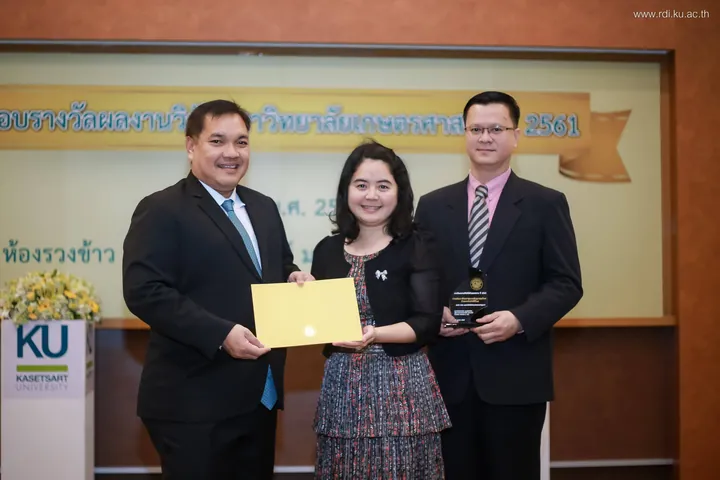 Holding an award on stage at the Kasetsart University research awards, October 2020 · KU Research and Development Institute (opens in a new tab)
 Outstanding Animal Scientist 2018 (academic category), Animal Husbandry Association of Thailand · Animal Husbandry Association of Thailand (opens in a new tab)
3(3-0-6) credits
Increasing efficiency of animal breeding, animal genetics technology and molecular biology, genomic genotyping, genomic diversity and association, selection accuracy, mating plan, genomic evaluation system, measuring the achievement of animal breeding.
3(3-0-6) credits
Advanced research in animal science and preparation of research proposal, application of information technology and computer data processing and retrievals, data analysis, article writing and presentation, group discussion, paper preparation for presentation and publication.
1 credits
Presentation and discussion on interesting topics in animal science at the doctoral degree level.
1-3 credits
Study research in animal science at the doctoral degree level and compile into a written report.
1-72 credits
Research at the doctoral degree level and compile into a thesis.
3(3-0-6) credits
Principle and process of genetic evaluation, best linear unbiased prediction, correction and connection of the dataset, animal genetic models and Testing, statistical processing, translation and utilization, reports for animal genetic evaluation.
3(3-0-6) credits
Current situation of dairy production industry, production and reproduction cycles of dairy cattle, genetics related to economically important traits, population structure analysis, determination of breeding objectives, breeding plan and designs, selection program, mating schemes, data recording, genetic evaluation, monitoring genetic progress.
3(3-0-6) credits
Research techniques and methods, problem analysis, hypothesis formation, experimental design and research plan, data sampling, data science, models and assumptions, statistical analysis, computer programming and its utilization, interpreting and reporting techniques for statistical results.
1 credits
Presentation and discussion on current interesting topics in animal science at the master’s degree level.
1-3 credits
Study and research in animal science at the master’s degree level and compile into a written report.
1-36 credits
Research at the master’s degree level and compile into a thesis.
3(3-0-6) credits
Importance of animal production. Relationship to other agricultural production sectors. Science and technology in animal production. Farm management and the environment. Primary products and animal products. Livestock marketing. Future trend of animal production.
Commercial dairy farm management from calf to lactating cow. Utilization of roughage, meal concentrate and total mixed ration for dairy cattle feeding. Dairy herd management and seasonal milk production. Milking and milk collection center management. Ready to drink milk and milk product processing. Good quality beef production from dairy male cattle. Risk assessment management in dairy industry.
3(3-0-6) credits
Genetics. Mathematics. Statistics for animal breeding. Influences of genetic and environment on animal phenotype. Estimation of heritability. Repeatability. Genetic correlation. Selection and mating systems for genetic improvement of livestock. biotechnology in animal breeding.
3(3-0-6) credits
Data occurring in animal production system. Systematic designing, planning, and data recording. Statistics for animal production. Software for data recording and utilization. Reporting and guideline for suggestion.
1 credits
Presentation and discussion on current interesting topics in animal industry at the bachelor’s degree level.
3 credits
Study and research in communication and animal science at the bachelor’s degree level and compile into a written report.
The questions people ask most, each answered in a few lines.
Prof. Dr. Skorn Koonawootrittriron is a Thai animal geneticist, Professor of Animal Breeding and Vice President for Area-Based Mission Integration at Kasetsart University, Bangkok. He heads the Tropical Animal Genetic Special Research Unit (TAGU) in the Department of Animal Science, and was named a 2026 National Outstanding Researcher by the National Research Council of Thailand (NRCT).
Prof. Skorn has been Vice President for Area-Based Mission Integration of Kasetsart University since 2026, under President Asst. Prof. Dr. Kongsak Thiangtham. He oversees KU's research centers and research stations, the Kasetsart University Radio Station and the Princess Sirindhorn Center for Sustainable Development. He is also Professor of Animal Breeding and has chaired the Graduate Program in Animal Science since 2017.
Prof. Skorn is best known for Thailand's dairy cattle genetic evaluation, run by the Dairy Farming Promotion Organization of Thailand (DPO) with Kasetsart University and the University of Florida since 1996 using models he co-developed, and for its genomic version, in use at DPO since 2013. Kasetsart University reported in 2020 that, with genomic evaluation, farmers obtain genetically superior replacement cows about 7.4 months (14.8%) sooner. The 2026 evaluation covers 14,662 cows on 1,326 farms.
Prof. Skorn was named a 2026 National Outstanding Researcher (Agricultural and Biological Sciences) by the National Research Council of Thailand. Other honours include Outstanding Technologist 2021, Kasetsart University's Platinum-level Impactful Research Award 2024 for the research team he led, Outstanding Thai Buffalo Researcher 2025 and Outstanding Animal Scientist 2018 from the Animal Husbandry Association of Thailand.
Skorn Koonawootrittriron was appointed Professor of Animal Breeding with effect from 4 February 2022; the appointment was published in the Royal Gazette on 20 January 2026. He became Assistant Professor in 2004 and Associate Professor in 2017.
Prof. Skorn works on quantitative and genomic genetics for tropical livestock: genetic evaluation, genomic selection, crossbreeding and breeding programs for dairy and beef cattle, swamp buffalo, pigs, chickens, fish and shrimp.
Prof. Skorn has published more than 115 peer-reviewed journal articles and over 160 conference papers. As of October 2026, his Google Scholar profile shows 1,968 citations, an h-index of 25 and an i10-index of 66; his Scopus h-index is 18.
His most cited paper is "Origin and evolutionary history of domestic chickens inferred from a large population study of red junglefowls and indigenous chickens in Thailand" (Scientific Reports, 2021; doi:10.1038/s41598-021-81589-7), with 96 Google Scholar citations as of October 2026. Other widely cited work covers Ethiopian sheep, Ethiopian multibreed dairy cattle and genetic trends in Thai Holstein multibreed cattle.
Prof. Skorn led Kasetsart University's side of the 2023 Buffalo Sire & Dam Summary with the CP Foundation's Buffalo Modern Farm, described at its launch as Southeast Asia's first (ISBN 978-616-94343-0-6; second edition 2025), under a 2023–2028 Kasetsart University–CP Foundation agreement. He serves on the support team of the Thai Buffalo Conservation and Development Project, a royal project of King Rama X, and was named Outstanding Thai Buffalo Researcher 2025.
A 2024 SROI assessment by Thammasat University, cited in his CV, estimates that the research program he leads returns 3.65 baht per baht invested, with 9.84 baht projected by 2029.
Prof. Skorn has advised about 65 graduate theses: 31 as main advisor (11 Ph.D.) and 34 as co-advisor. His graduates come from Thailand, Ethiopia, Japan and Myanmar, and include the first graduate of Kasetsart University's joint Ph.D. program with Nagoya University (2021).
Prof. Skorn is Editor-in-Chief of the Thai Journal of Agricultural Science (since 2021) and of the Agricultural Science and Innovation Journal (since 2017), Associate Editor of Agriculture and Natural Resources (ANRES), and Section Editor of Genomics and Genetics.
The Tropical Animal Genetic Special Research Unit (TAGU) is a Kasetsart University research unit, founded and led by Prof. Skorn Koonawootrittriron, that develops genetic and genomic tools for tropical livestock and aquaculture and puts them to work with farmers, cooperatives and industry.
Prof. Skorn earned all three degrees at Kasetsart University: B.S. in Agriculture (1994), M.S. in Agriculture (1997) and Ph.D. in Animal Science (2002), with his doctoral research carried out jointly with the University of Florida.
Prof. Skorn began as a lecturer at the Rajamangala Institute of Technology in Sakon Nakhon (1997–2003) and joined Kasetsart University's Department of Animal Science in 2003. He was Associate Dean for Research of the Faculty of Agriculture (2014–2017), a courtesy faculty member at the University of Florida (2005–2023), and became Vice President of Kasetsart University in 2026.
Yes. Prof. Skorn chairs Kasetsart University's Graduate Program in Animal Science (M.S. and Ph.D.) and supervises graduate students in TAGU, including international students. Topics, language and funding are explained on the Join TAGU page; start by emailing agrskk@ku.ac.th with your research interest.
His name is Skorn Koonawootrittriron (given name Skorn, family name Koonawootrittriron). In Thai it is ศกร คุณวุฒิฤทธิรณ, formally ศาสตราจารย์ ดร.ศกร คุณวุฒิฤทธิรณ or อาจารย์ศกร. Scientific papers cite him as S. Koonawootrittriron or Koonawootrittriron S.
Prof. Skorn can be reached by email at agrskk@ku.ac.th. The Vice President's office at Kasetsart University is on 0-2942-8188-9, and the Department of Animal Science, Faculty of Agriculture, Kasetsart University, Bangkok, is on 0-2579-1120.
Checked in October 2026 against Kasetsart University, the Royal Gazette, NRCT, his CV and Google Scholar.
Explore the research themes, publications and impact, or get in touch about collaboration.